By the time a child walks into kindergarten, the most important chapter of their literacy development is already written. That's not an exaggeration. The first five years of life — from birth through the preschool years — represent the single most critical window for language and literacy development that a human being will ever experience.
The vocabulary a child has at age five predicts reading comprehension in third grade. Their phonological awareness at age four predicts spelling and decoding in first grade. The number of words spoken to them in their first three years predicts academic outcomes that persist into high school and beyond.
These are not soft correlations. They are among the most robustly replicated findings in developmental science — and they have profound implications for how we think about early childhood care and education.
For parents, the question this raises is urgent: What is happening to my child’s language and literacy development right now, every day — and is it enough?
This article breaks down what the science actually says about how language and literacy develop in the first five years, what that looks like at each developmental stage, and how quality early childhood programs — including the program at Baby Genius Daycare in Langhorne, PA — actively support these foundational skills in ways that shape everything that follows.
The Science of Early Language: What’s Happening in That Developing Brain
Language acquisition is one of the most extraordinary things a human brain does — and it does most of it in the first five years, without formal instruction, almost entirely through exposure and interaction.
At birth, a baby’s brain contains roughly 100 billion neurons — essentially all the neurons they’ll ever have. What changes dramatically over the first years of life is the connections between those neurons: the synaptic pathways that form in response to experience, interaction, and stimulation. Language-rich environments build dense, well-connected language networks. Language-sparse environments build weaker ones — and those differences are visible in brain scans by age two.
The mechanism behind this is what Harvard’s Center on the Developing Child calls “serve and return” — the back-and-forth interaction between a child and a caregiver that is the fundamental unit of language learning. A baby babbles (serves). An adult responds with words and expression (returns). The baby responds again (serves again). This tennis-match of interaction — repeated thousands of times a day across the first years of life — literally builds the architecture of the language-learning brain.
Every time a caregiver narrates what they’re doing, responds to a child’s vocalization, names an object a child points to, reads aloud, sings a song, or asks a question and waits for an answer, they are performing neural construction. Every time a child is left to a screen without interaction, that construction pauses.
This is why who is with your child — and what those adults do — matters so much in the early years.
The 30 Million Word Gap — and Why It Matters for Every Family
In 1995, researchers Betty Hart and Todd Risley published one of the most influential studies in early childhood development history. Over four years, they tracked the language environments of children from different socioeconomic backgrounds — recording every word spoken to and around each child from birth to age three.
Their finding — now known as the “30 Million Word Gap” — was stark: children from more language-rich households heard up to 30 million more words by age three than children from more language-sparse ones. And that gap in words heard translated directly into a gap in vocabulary size, language processing speed, and academic performance that was still measurable at age nine.
Importantly, subsequent research has refined and complicated the original study’s socioeconomic framing. The word gap, researchers now understand, is less about income and more about interaction quality — the responsiveness, richness, and back-and-forth nature of language in a child’s environment. Quantity of words matters, but the quality and interactivity of language matters more.
The takeaway for parents is not guilt — it’s information. Language-rich, responsive interaction with the adults in a child’s life is the primary driver of early language development. And since children spend a significant portion of their waking hours in early childcare settings, the language environment of those settings is not incidental. It’s foundational.
A teacher who narrates, questions, sings, reads, and responds is doing literacy work. A screen is not.
Language and Literacy Development: A Stage-by-Stage Guide
Language and literacy don’t begin when a child picks up a book in kindergarten. They begin at birth — and unfold in a predictable, research-documented sequence across the first five years. Here’s what each stage looks like, and what quality caregiving supports at each point.
Birth to 12 Months: The Foundation Is Laid
Infants are born ready to acquire language. From the moment of birth, babies distinguish their home language from other languages, recognize their parents’ voices, and prefer speech sounds over other kinds of audio input. By two months, they coo and gurgle in response to caregivers. By six months, they babble — strings of consonant-vowel combinations that are the first rehearsal for words. By twelve months, most children say their first word.
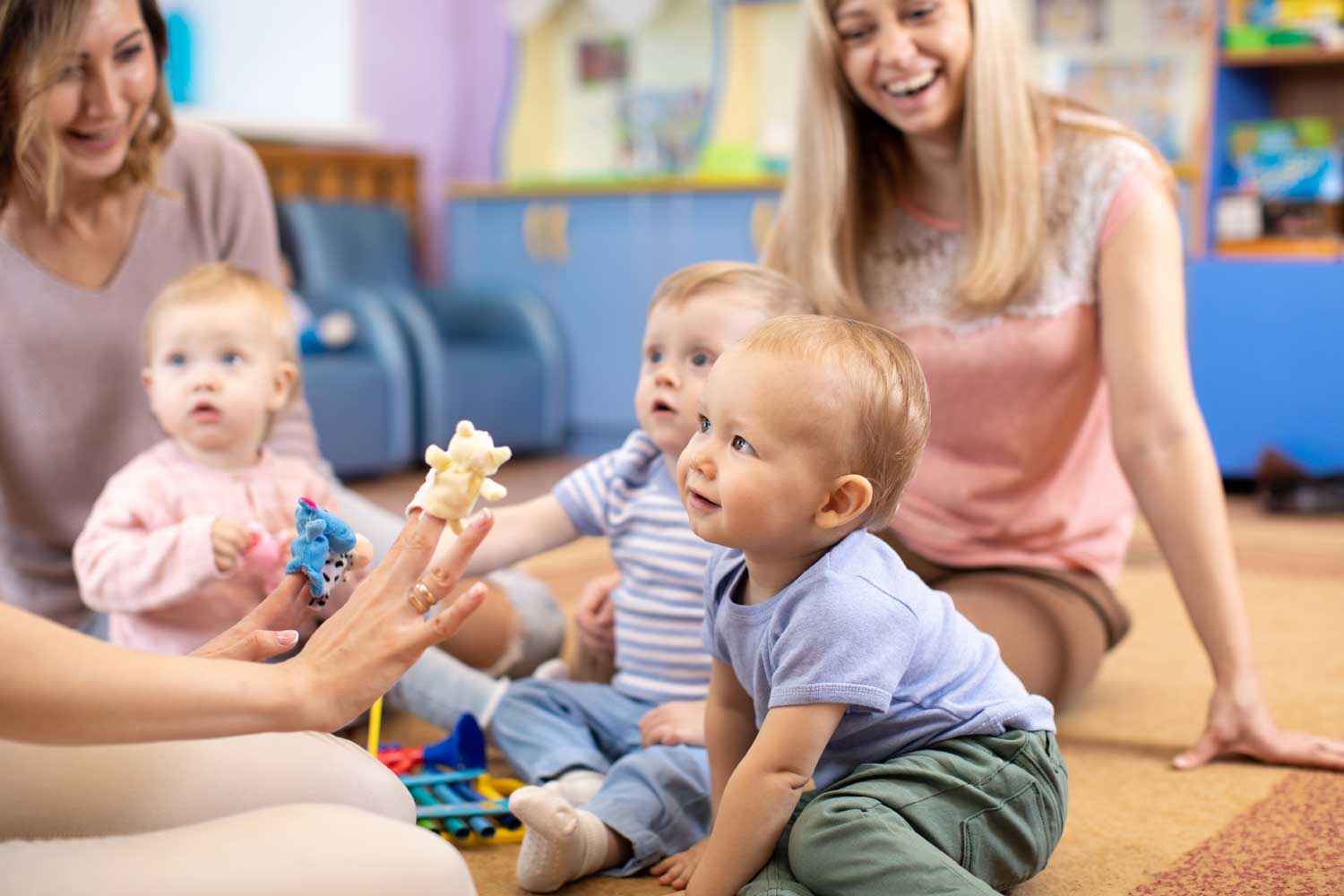
What builds language in this stage: responsive, face-to-face interaction. Narrating diaper changes, singing during feeding, responding to every coo and babble as if it were a real conversation — this is the work of infant language development. It doesn’t require flashcards. It requires presence and responsiveness.
The CDC’s developmental milestones provide a clear roadmap for what language development should look like at each age — from birth through five years. Parents who have concerns about their child’s language development at any stage should raise them with their pediatrician.
At Baby Genius Daycare, our Infant Care program is built around exactly this kind of responsive, language-rich caregiving. Our infant caregivers talk to babies constantly — naming, narrating, singing, and responding — because they understand that every interaction is language instruction. Read more about what infant care at Baby Genius looks like in our guide What to Expect from Infant Care.
12 to 24 Months: The Vocabulary Explosion
Somewhere between 12 and 18 months, most toddlers experience what researchers call the “vocabulary explosion” — a sudden acceleration in word learning that takes children from a handful of words to dozens, then hundreds, in a matter of months. By 24 months, most children use 50 or more words and are beginning to combine two words (“more milk,” “daddy go,” “big dog”).
This is also the stage when joint attention — the ability to share focus on an object or event with another person — becomes the primary vehicle for word learning. A toddler points to a dog. The caregiver says “dog! Big dog! The dog is fluffy!” The toddler learns the word, the concept, and the back-and-forth of shared attention simultaneously.
What supports language at this stage: naming everything, expanding on what a child says (“ball” → “Yes! A big red ball!”), reading simple books with repetition and pictures, and providing a language-rich environment where talking is a natural, constant part of every activity.
Our Toddler Care program at Baby Genius is designed around this developmental moment. Teachers engage in constant, responsive conversation with toddlers — not talking at them, but talking with them, building the vocabulary and conversational turn-taking that this stage demands.
2 to 3 Years: Grammar, Questions, and Storytelling
The two-to-three age window is when language gets remarkably complex remarkably fast. Children move from two-word combinations to full sentences. They begin using pronouns, verb tenses, and plurals — often incorrectly at first (“I goed to the store,” “she runned fast”) in ways that actually demonstrate they’ve internalized grammatical rules rather than just memorized phrases.
Questions explode at this stage — the relentless “why” and “what’s that” and “how come” that characterizes the two- and three-year-old experience. These questions are not just social. They are the primary mechanism through which children extend their understanding of the world and deepen their vocabulary. Every patient, genuine answer a caregiver gives is building language and knowledge simultaneously.
Storytelling also begins at this stage — simple narratives about what happened at the park, what they’re building with blocks, what they dreamed. This narrative language is the direct precursor to reading comprehension: the ability to track a sequence of events, understand cause and effect, and hold a storyline in mind. Children who tell and hear stories at age three are better readers at age eight.
According to Zero to Three, the quality of conversation in a two-to-three-year-old’s environment is the single greatest predictor of language ability at school entry. Not the quantity of books, not the educational toys — the conversation.
3 to 4 Years: Phonological Awareness Emerges
As children move into the preschool years, a new and critically important language skill emerges: phonological awareness — the ability to hear, identify, and manipulate the sound structures of language. This includes recognizing rhyme, clapping syllables, identifying beginning sounds, and — eventually — isolating individual phonemes (the smallest units of sound in a word).
Phonological awareness is the strongest predictor of early reading success we have. Reading Rockets and the National Reading Panel both identify phonological awareness as one of the five essential components of reading — and unlike vocabulary or comprehension, it can be directly and explicitly taught through play-based activities at the preschool level.
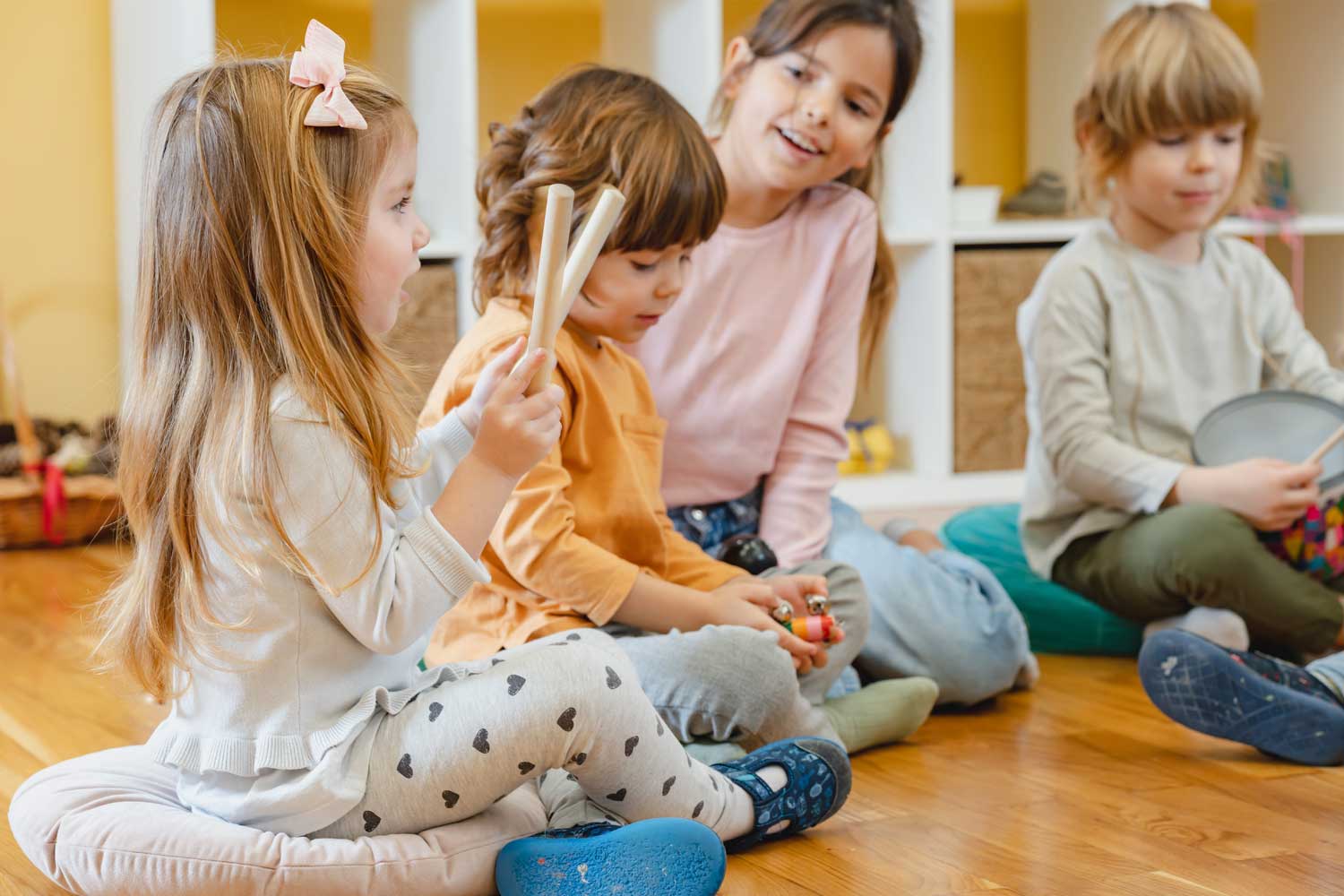
Songs, rhymes, tongue twisters, word games, and alliterative stories all build phonological awareness in preschoolers. This is why a classroom that sings, rhymes, and plays with language is doing more than keeping children entertained. It is doing pre-reading instruction — the kind that produces measurably better readers two and three years later.
At Baby Genius Daycare, phonological awareness is woven into our Preschool and Pre-K programs through songs, rhyming games, read-alouds with attention to sound patterns, and the letter-focused activities that run through our Mother Goose Time curriculum. Children are playing — but the play is intentionally structured to build the exact skills that predict reading success.
4 to 5 Years: The Bridge to Reading
By age four and five, children in language-rich environments are typically doing things that look a lot like early reading — even before they can decode a single word. They “read” familiar books from memory, following along with text and turning pages at the right moments. They recognize their own name in print. They understand that text goes left to right and top to bottom. They know that the marks on the page correspond to the words being spoken. This is called print awareness, and it is the final major milestone before formal reading begins.
Children who arrive at kindergarten with strong phonological awareness, a rich vocabulary, solid print awareness, and a love of books — built through years of being read to, talked to, and immersed in language — learn to read more easily, more quickly, and with greater comprehension than children who arrive without these foundations.
The National Association for the Education of Young Children is clear: reading aloud to children is the single most important thing adults can do to prepare children for literacy success. Not phonics drills. Not alphabet worksheets. Reading aloud — rich, expressive, interactive read-alouds where adults pause, ask questions, make predictions, and connect stories to a child’s own life.
Baby Genius Daycare’s Pre-K and Pre-K Counts programs are specifically designed to develop these kindergarten-readiness skills — including interactive read-alouds, letter recognition, name writing, phoneme identification, and early sight word exposure — all through play-based, developmentally appropriate activities that children experience as fun, not as work. Learn more about Pre-K readiness signs and how our program prepares children for the transition.
How Quality Daycare Actively Supports Language and Literacy Every Day
Quality early childhood programs don’t leave language development to chance. They build it intentionally — through the environment they create, the interactions they model, and the curriculum they implement. Here’s what that looks like in practice at Baby Genius Daycare:
📚 Daily Read-Alouds at Every Age Level
From the infant room to the Pre-K classroom, read-alouds happen every single day at Baby Genius. For infants, this means simple board books with repetitive language and bright images. For toddlers, books with more complex vocabulary and narrative. For preschoolers and Pre-K children, longer stories with richer language, followed by discussion, prediction, and connection to the child’s own experience. The American Academy of Pediatrics recommends reading aloud to children from birth — and we take that recommendation seriously at every level of our program.
🗣️ Intentional, Responsive Conversation Throughout the Day
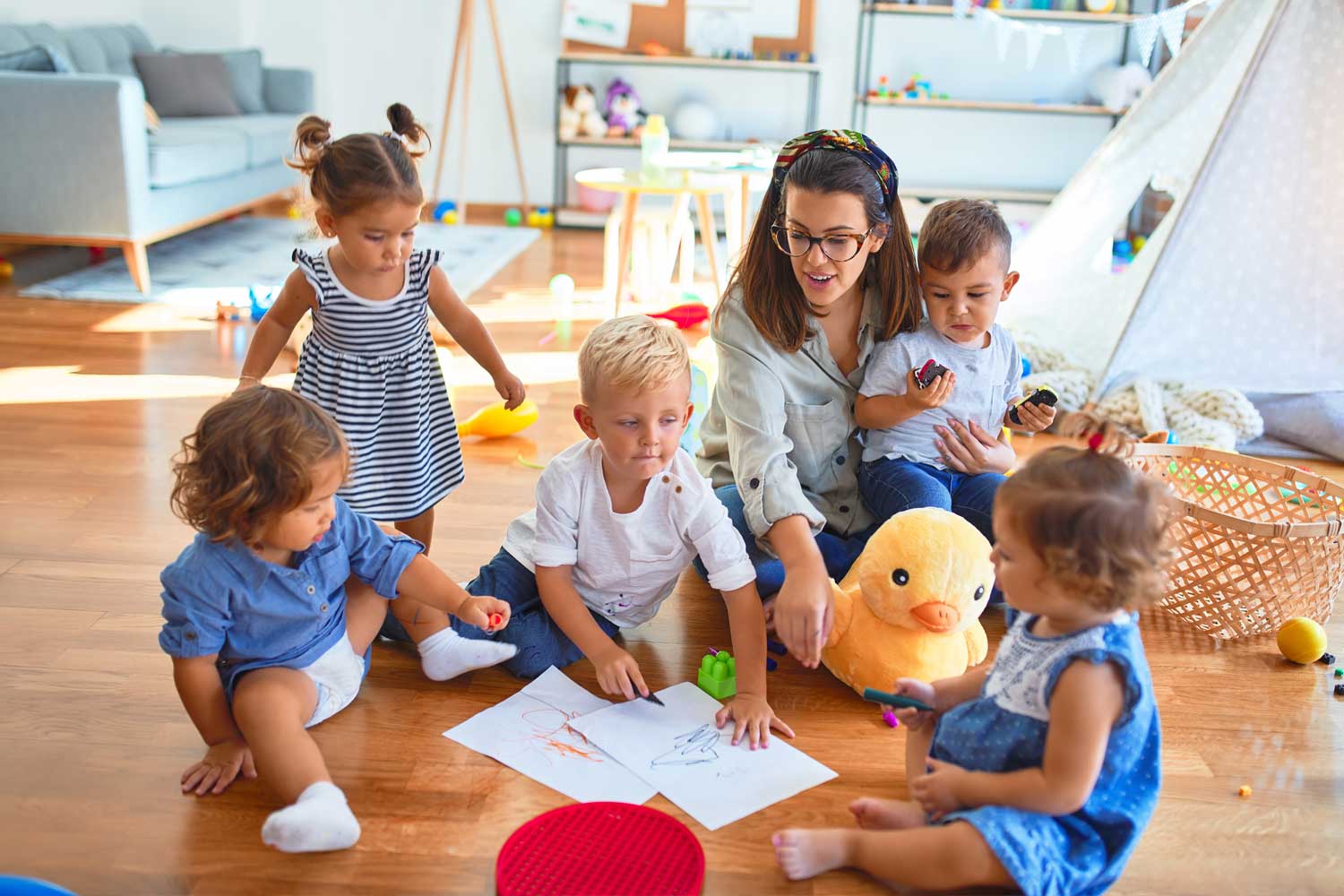
Baby Genius teachers are trained to use conversation as a teaching tool — not just a social nicety. This means using rich, varied vocabulary in everyday interactions. It means asking open-ended questions that require more than a yes or no. It means expanding on what children say (“you’re right, it is big — it’s enormous!”). It means waiting for an answer rather than moving on. These conversational techniques — which researchers call “language facilitation strategies” — are among the most powerful tools in a teacher’s literacy toolkit.
🎵 Songs, Rhymes, and Phonological Play
Music and rhyme are literacy instruction in disguise. When children learn a new song, they’re building phonological awareness, vocabulary, memory, and sequential thinking simultaneously. When they clap syllables, they’re developing the segmentation skills that underpin spelling. When they play with rhyme, they’re training the phoneme sensitivity that predicts reading success. Our teachers use songs, fingerplays, rhyming games, and tongue twisters deliberately — because they understand the developmental work these activities accomplish.
📖 A Research-Based Curriculum With Literacy at Its Core
The Mother Goose Time curriculum used at Baby Genius Daycare integrates language and literacy development into every monthly theme, every daily activity, and every classroom interaction. Letter of the week, vocabulary words connected to the theme, shared reading, dramatic storytelling, and print-rich classroom environments are all built into the curriculum’s framework — ensuring that literacy development isn’t left to chance or individual teacher preference. You can read more about our approach on our Curriculum page.
🏛️ Print-Rich Classroom Environments
In high-quality early childhood classrooms, print is everywhere — and it’s meaningful print, not decoration. Children’s names on their cubbies and artwork. Labels on classroom materials at children’s eye level. The daily schedule written in words and pictures. Books in every learning center. Word walls connected to the month’s theme. Environmental print like this builds print awareness passively — children absorb the concept that letters make words and words carry meaning simply by living in a classroom where that’s visibly true.
🌟 A 4-Star Standard That Includes Literacy
Baby Genius Daycare’s 4-star Keystone STARS rating — Pennsylvania’s highest quality designation for early learning programs — requires verified use of a research-based curriculum and documented evidence of intentional teaching practices. Our commitment to language and literacy development isn’t a marketing claim. It’s embedded in the standards we’re evaluated against and the practices we’re accountable to every day.
What Parents Can Do at Home to Support Language and Literacy
Quality daycare and quality home environments work together — and the research is clear that children benefit most when language-rich practices happen in both places. Here are the most impactful things parents of children under five can do at home:
- Read aloud every day. Even ten minutes a day of shared reading — starting from birth — builds vocabulary, comprehension, print awareness, and a love of books that no screen can replicate. The books don’t need to be educational. They need to be read, with expression, together.
- Talk more than you think you need to. Narrate your day. Describe what you’re cooking. Ask your toddler what color the leaves are. Tell your preschooler what you’re doing at the grocery store and why. Every conversation is vocabulary instruction.
- Expand, don’t correct. When a child says “I goed to the park,” don’t correct — expand. “You went to the park! What did you do there?” This models the correct form without shutting down the conversation or creating self-consciousness about speaking.
- Sing together. Songs are phonological awareness builders that feel like pure joy. Nursery rhymes, silly songs, made-up songs about what you’re doing — all of it counts.
- Ask “what do you think?” — and mean it. Open-ended questions that invite real answers, followed by genuine listening, are among the most powerful language-development tools available to parents. Children whose opinions are sought develop richer, more complex language faster than children who are mostly talked at.
When home and care environments are both language-rich and consistent in their approach, children get the repetition and reinforcement their developing brains need to build lasting language and literacy skills. Our Procare Parent App helps Baby Genius families stay connected to what’s happening in the classroom — so parents can extend the day’s learning at home with the same vocabulary, books, and themes their child explored at daycare.
Language and Literacy Start Here — Let’s Build Them Together
The first five years of language development are not a rehearsal. They are the performance — the window during which the foundations for everything that follows are laid, reinforced, and made permanent. What happens in those years, in the environments where children spend their time, shapes the readers, communicators, and thinkers they will become.
At Baby Genius Daycare in Langhorne, PA, we take that responsibility seriously. Our teachers are trained in language facilitation. Our curriculum is research-based and literacy-integrated. Our classroom environments are print-rich and language-soaked. And our program — from the infant room through Pre-K — is designed to give every child the language and literacy foundation that sets them up for a lifetime of learning.
We serve families from Langhorne, Newtown, Yardley, Bristol, Levittown, Bensalem, and throughout Bucks County, PA. We’d love to show you our classrooms, introduce you to our teachers, and talk about how we support your child’s specific developmental stage.
See what Baby Genius families say about the difference they’ve seen in their children’s language and communication. Then come see it for yourself.
📞 Call us at 215-752-1132 or schedule a tour online. We’re located at 517 East Lincoln Highway, Langhorne, PA 19047.
Baby Genius Daycare is a licensed, 4-star Keystone STARS early learning center in Langhorne, PA, offering language-rich, literacy-integrated programs for children from infancy through school age. Proudly serving families throughout Bucks County and surrounding communities.